
Cracking your own back might feel good for a moment, but it is a general, unfocused movement that pops several joints at once, while a chiropractic adjustment is a precise, targeted move applied to a specific joint that needs it. The temporary relief from self-cracking usually comes from the joints around the actual problem, not the problem itself. At RAK Chiropractic in Rochester, the difference between the two comes down to precision and purpose.
What That Popping Sound Actually Is
First, let us clear up the pop, because it causes a lot of confusion. The sound is not your bones grinding or anything cracking in a harmful sense.
Your joints are surrounded by fluid that contains dissolved gases. When a joint is stretched and the pressure changes quickly, those gases release in a little pocket, and that is the pop you hear. The scientific name is cavitation.
The sound itself is not the point of an adjustment, and it is not a measure of success. A good adjustment can happen with or without an audible pop. The noise is just a byproduct.
Why Self-Cracking Feels Good (For a Minute)
When you twist to crack your own back, you usually feel a brief sense of relief. That feeling is real, but it is worth understanding where it comes from.
Self-cracking is a broad movement. You are twisting your whole spine and popping whatever joints move most easily, which are often the ones that are already loose and mobile, not the stiff, restricted ones causing the problem.
The temporary relief comes partly from a brief release of tension and partly from the feel-good response the body has to the movement. The trouble is that the actual restricted joint, the one that needs attention, usually is not the one that popped.
The Core Difference: Precision
Here is the heart of it. Cracking your own back is general and unfocused. A chiropractic adjustment is specific and targeted.
When you self-crack, you cannot isolate the exact joint that needs help. You move a whole region and pop the easy joints. The stiff, stuck joint that is actually driving your pain often gets skipped entirely.
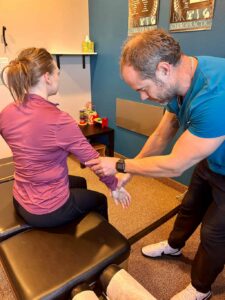
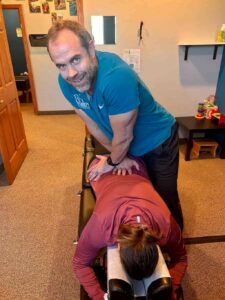
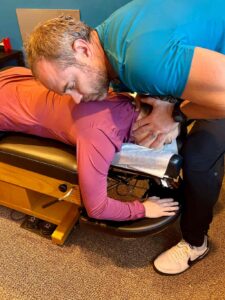
A chiropractor evaluates which specific joint is restricted and applies a precise, controlled force to that joint. The adjustment goes to the segment that needs it, not the ones that already move fine. That precision is the entire difference.
The Risk of Habitual Self-Cracking
Cracking your back once in a while is generally not a big deal. Doing it constantly, though, can create problems worth knowing about.
You Can Overstretch Already-Loose Joints
Because self-cracking targets the mobile joints, repeatedly popping them can make them even looser over time. Excess mobility in the wrong joints is not a good thing. It can lead to instability.
You Are Not Fixing the Real Problem
If you feel the constant urge to crack your back, that urge is often a sign that a nearby joint is restricted. The loose joints keep popping to compensate, but the stiff one stays stuck. You end up chasing relief without addressing the cause. Our back pain relief page explains this pattern.
The Relief Never Lasts
Because the actual issue goes unaddressed, the relief from self-cracking fades fast and the tension comes right back. That cycle can go on indefinitely without ever solving anything.
What a Real Adjustment Does Differently
A chiropractic adjustment is built around finding and treating the specific source of a problem, which is a different goal entirely from a quick self-pop.
It Starts With an Evaluation
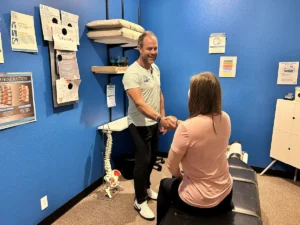
Before any adjustment, a chiropractor assesses your spine to find which joints are actually restricted. You cannot do this to yourself. That assessment is what makes the adjustment targeted. You can read more on our chiropractic care page.
It Targets the Right Joint
The adjustment applies controlled force to the specific segment that needs it. That is what restores proper motion to the joint that has been stuck, rather than just moving the ones that were fine.
It Addresses the Root Cause
By treating the restricted joint, an adjustment aims to resolve the reason you felt the urge to crack in the first place. That is the difference between managing a symptom and addressing the cause.
Multiple Techniques for the Right Fit
Not every adjustment looks the same, and not everyone needs the same approach. Dr. Ryley Layden is trained in several techniques, including Upper Cervical, Thompson Drop Table, Diversified, Activator, and manual adjusting.
Some patients prefer or need gentler methods, and the Activator, for instance, uses a small instrument rather than manual force. The technique is matched to the person, which is something self-cracking obviously cannot offer.
If You Keep Wanting to Crack Your Back
Feeling the constant need to pop your own back is worth paying attention to. It usually means something in your spine is not moving the way it should, and the popping is your body’s attempt to compensate.
Rather than chasing that temporary relief, an evaluation can find the restricted joint and address it properly. For a lot of Rochester patients, that breaks the cycle for good.
Tired of cracking your back for relief that never lasts? Contact RAK Chiropractic in Rochester at 507-208-4305 or reach out online.